
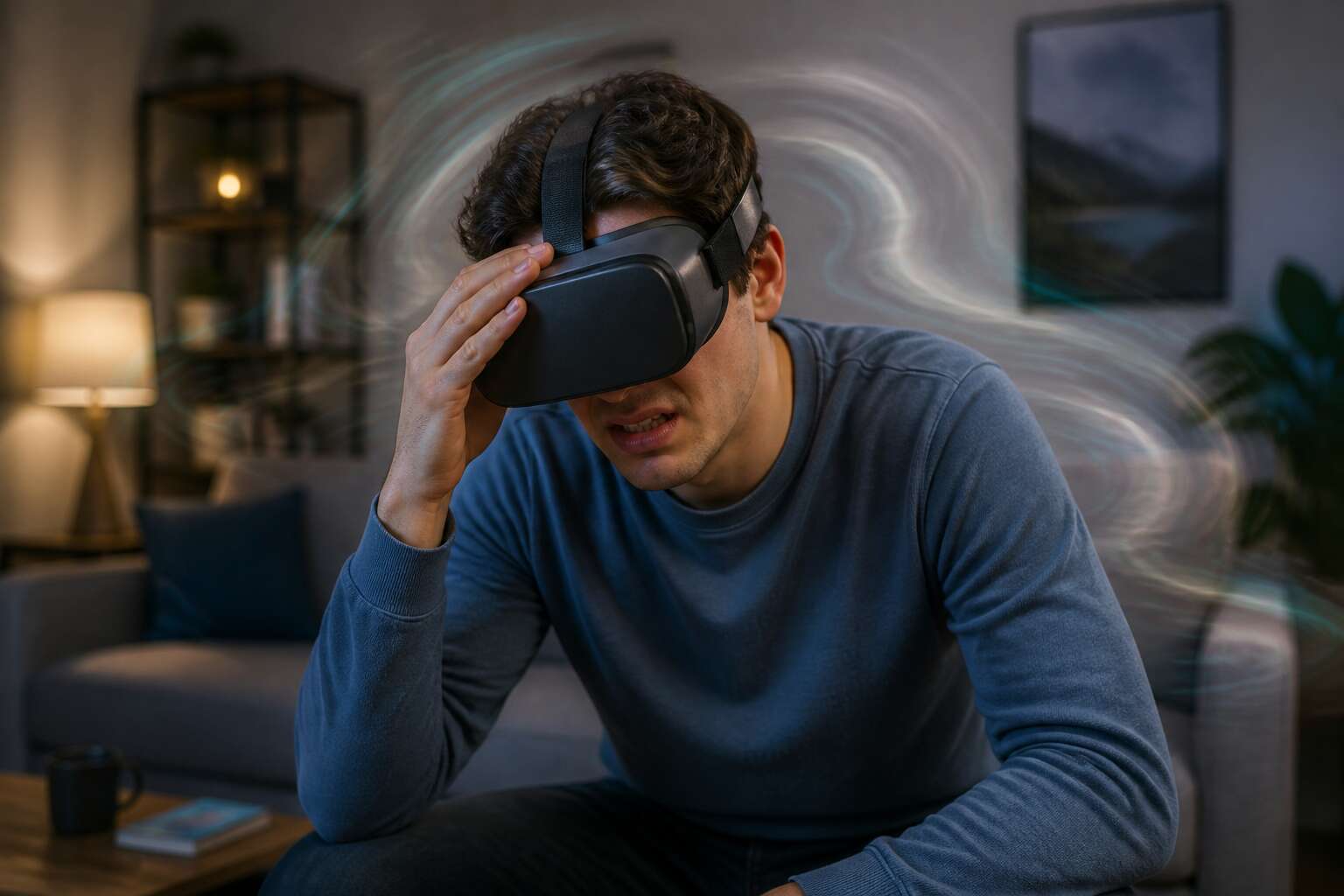
Understanding Virtual Reality Induced Discomfort
What Is VR Sickness?
Virtual reality sickness arises from sensory conflict. Your eyes see motion, but your inner ear detects no movement. The brain receives contradictory input, which triggers nausea, dizziness, and disorientation. This condition has affected simulation training for decades.
Researchers call it cybersickness. It occurs when the visual system and vestibular system disagree. The following symptoms appear within minutes:
- Cold sweats and pallor
- Stomach awareness or queasiness
- Eye strain and headache
So can virtual reality make you sick? Yes, and the risk varies with headset quality, frame rate, and susceptibility. Some people adapt. Others never do!
Difference Between Motion Sickness and VR Sickness
Roughly half of first time headset users feel queasiness within minutes. That discomfort is not motion sickness, though the symptoms look identical. Motion sickness follows actual acceleration, like a taxi weaving through Johannesburg traffic. The inner ear, skin, and muscles all confirm the movement. VR sickness springs from an optical illusion. Your eyes register speed, but your body stays still. The brain gets mixed reports. So can virtual reality make you sick? Yes, but unlike a bumpy ride, no physical force is present. This is why some people can handle a boat for hours, then feel sickly after a ten minute headset demo. Susceptibility varies with age, eye strain, and prior concussion history.
The Role of the Vestibular System
The vestibular system, a labyrinth of canals and fluid-filled sensors within the inner ear, governs balance and spatial orientation. When you slip on a headset, your eyes relay a convincing image of motion, but your vestibular system reports stillness. This sensory mismatch drives virtual reality induced discomfort.
I have watched colleagues who can read in a moving car without issue, only to feel unsteady after a few minutes in a demo. So can virtual reality make you sick? Absolutely! The sickness does not come from motion itself, but from the contradiction your inner ear refuses to accept. Your body knows it has not moved, yet your eyes insist otherwise.
Why Your Eyes and Brain Conflict
Roughly a third of first-time headset users feel uneasy within minutes. The discomfort begins in the visual system, before the inner ear even registers a problem. When a virtual ball speeds toward your face, your pupils contract and your eye lenses change shape to focus on an object that does not exist.
The brain now faces contradictory depth signals from separate visual pathways:
- Accommodation insists the object is close
- Convergence pulls the eyes inward to track a target
- Peripheral vision reports an absence of natural motion blur
Each signal carries its own logic, yet they conflict with one another. The brain prioritises visual input above other senses, so it tends to accept what the eyes show. That acceptance causes trouble once the rest of the nervous system pushes back.
So can virtual reality make you sick? Yes. The sickness is the brain’s alarm response to receiving visual data the body cannot verify. Your eyes are telling you the world is moving, and every other system in your body is telling you the opposite.
How the Brain Adapts to Virtual Environments
The brain is a remarkably accommodating organ. When virtual environments first deceive it, the result is discomfort. But given time, the brain begins to reclassify the experience. It learns to treat the headset’s input as a peculiar form of reality, one where motion and stillness can coexist.
This adaptation relies on neuroplasticity. The brain rewires its expectations, gradually lowering the alarm response. For many users, symptoms fade after several sessions. For others, the recalibration never quite takes hold. That variance explains why some people adapt quickly while others remain sensitive.
Consider what the brain must reconcile:
– The visual world insists on movement, while the inner ear insists on stillness.
– Depth cues conflict with spatial anchors.
– The body’s usual reference points disappear entirely.
These contradictions are the true source of the sickness. So can virtual reality make you sick? Yes, it can, but the brain’s willingness to adapt often determines how long the sickness lasts.
Common Symptoms and Warning Signs
Physical Symptoms: Nausea and Dizziness
Your head remains still, but your stomach churns. One clear answer to can virtual reality make you sick is a creeping nausea. Dizziness follows, leaving you unsteady even when you are standing on solid ground. The sensation intensifies with every virtual step you take.
The physical signals are hard to ignore. You might notice:
- A cold sweat on your forehead.
- A persistent wobble in your balance.
- An urgent need to sit down.
These reactions stem from a mismatch between what your eyes see and what your inner ear reports. Your body interprets this conflict as a threat, and nausea becomes its defense. It is a protective mechanism, albeit one that ruins your afternoon.
Visual Symptoms: Eye Strain and Headaches
Nearly 70% of VR users report some form of eye strain after just 20 minutes of use. The visual system works overtime, performing a delicate dance between focusing on close-up screens and tracking distant, virtual objects. This constant refocusing taxes the ciliary muscles, which control your lens shape, until they spasm and ache.
The result is a dull, persistent headache that creeps from behind the eyes. Your vision may blur, or you might notice a strange dry, scratchy feeling. Specific indicators to watch for include:
– Sore, burning eyes even after removing the headset
– A halo or ghosting effect around real-world objects
– Sharp pain behind the brow bone that worsens with eye movement
So, can virtual reality make you sick? Yes, and your eyes often sound the first alarm. The headache itself is a unique pressure, a heaviness that settles deep in the skull. It feels less like a typical tension headache and more like a quiet, insistent squeeze. This discomfort follows you out of the virtual world, hanging around long after you’ve returned to reality.
Psychological Symptoms: Confusion and Disorientation
Beyond the aching eyes lies a quieter, more unsettling symptom: disorientation. When the brain receives conflicting signals from vision and balance, the mind’s internal map of the world begins to fray. Users often report feeling detached from their own hands, or struggling to judge distances after removing the headset.
This confusion can persist for hours. In extreme cases, people describe a lingering dreamlike state, where the ground seems to tilt and walls appear closer than they are. Warning signs include:
- A persistent sense of floating or swaying while standing still
- Difficulty concentrating on a single object or task
- Feeling as though your hands move slower than you intend
Can virtual reality make you sick? Yes, and sometimes the sickness is not in the stomach but in the mind itself.
How Long Symptoms Last
Most people shake off the effects within 20 minutes of pulling off the headset. Others feel a strange heaviness for a few hours. A smaller group reports symptoms that linger into the next day. The duration depends on how long you stayed inside the simulation and how aggressively the software moved you.
A few warning signs suggest you are overdoing it:
– Sweating when you have not moved
– A sudden drop in energy
– The urge to close one eye to steady your focus
If you notice these, stop immediately. Pushing through does not build tolerance; it makes recovery slower. Can virtual reality make you sick? Yes, but the sickness usually fades once your feet touch solid ground again. That said, repeated sessions without proper breaks extend the aftereffects. The timeline matters. A quick 10 minute session leaves you clear headed, while an hour in a fast paced game can leave you unsteady well after dinner. Listen to your body during the first few minutes. That early discomfort is your best predictor of how long you will pay for it later.
When to Stop Using VR
Can virtual reality make you sick? The answer often reveals itself in small, quiet signals before any dramatic nausea. Watch for a persistent urge to grip something solid, a dull ringing in the ears, or the strange sense that the real room has started to tilt. These cues mean your nervous system is negotiating two conflicting realities.
Take them seriously. The longer you ignore them, the deeper the disorientation settles. You might also notice your breathing turning shallow without any physical effort, or a phantom pressure behind your eyes that has nothing to do with squinting. These are direct warnings from your body, not mere discomfort. Stop the session the moment they appear. Your brain cannot distinguish between virtual motion and actual danger in that state, and pushing forward only teaches it to mistrust the ground beneath you.
Delayed Effects and Afterimages
Sweat on the upper lip arrives before the first wave of nausea. A sudden yawn, a metallic taste in the mouth, a faint prickle of warmth across the back of the neck. These signals defy the voluntary. They surface without your permission, and they demand attention!
- Burping that occurs without eating
- Tunnel vision that narrows the edges of the room
- Afterimages that cling to the inside of the eyelids
Delayed effects manifest hours later, after the headset has been removed. The body retains the virtual motion and replays it while you lie still, making the mattress seem to drift. When we ask can virtual reality make you sick, the answer lives in this lag. The signs appear late, yet they originate in the same vestibular conflict that began mid session.
Who Is Most Likely to Experience VR Sickness
Age and Gender Factors
Can virtual reality make you sick? The evidence points to age and gender as two of the strongest demographic predictors for developing uncomfortable symptoms. Younger users, particularly adolescents, often exhibit heightened sensitivity because their vestibular systems are still calibrating to the world around them. This developmental window means that a teenager might feel nauseated within minutes, while a parent remains entirely unaffected.
- Adolescents under 20 report more frequent episodes of dizziness and vertigo.
- Adults over 50 generally show reduced reactions, though their visual acuity may introduce separate challenges.
Gender introduces a fascinating asymmetry in the data. Multiple studies confirm that women experience VR sickness at higher rates than men, potentially due to differences in peripheral field sensitivity or postural adaptation strategies. These are statistical tendencies, not absolute rules. A seasoned gamer might feel nothing whatsoever, while a colleague is overwhelmed after only a few seconds. Individual variability always transcends any demographic category.
Pre-existing Conditions
Certain medical histories load the dice before a headset even switches on. People who live with vestibular migraines often find themselves undone by virtual environments within minutes. Their balance systems already operate on a hair trigger, and the conflicting visual cues from a headset can tip them into full disorientation.
A prior diagnosis of Meniere’s disease or labyrinthitis amplifies the risk. These disorders disrupt the sensory hairs that tell your brain where your head is in space. Add virtual motion that contradicts what the inner ear reports, and the result can be swift.
- Chronic motion sickness from car or sea travel
- Concussion within the past year
- Ongoing vertigo medication
For those recovering from concussion, VR can interrupt the healing process. The question can virtual reality make you sick is not hypothetical for them. It is a daily concern requiring cautious testing.
Experience Level with VR
For someone stepping into a headset for the first time, the question can virtual reality make you sick feels immediate. Beginners have no trained reference point. Their brains have not yet learned to suppress the false signals coming from the display.
Experienced users are not immune either. A veteran who has spent hundreds of hours in one type of game can still feel queasy when they switch to a different movement style or a new device. The level of exposure matters more than raw time.
- Short, frequent sessions build tolerance
- Long gaps between sessions reset progress
- Different apps trigger different responses
That is why many developers warn that repeated use is the only way to know how your body will respond. The question can virtual reality make you sick never truly goes away. It simply becomes easier to predict.
Hardware and Software Influence
Why do two people in the same headset walk away with opposite memories, one thrilled, one green? Physiology sets the baseline. People with a low tolerance for visual-vestibular mismatch, or those who are fatigued, stressed, or sleep-deprived, often ask can virtual reality make you sick before finishing a first demo. Peripheral vision sensitivity and a tendency toward motion sensitivity in daily life also raise risk.
Hardware and software choices carry equal weight. A headset with a low refresh rate or poor lens calibration creates a smeared image that forces the brain to work overtime. Software that relies on joystick-based movement triggers more discomfort than room-scale or teleportation mechanics. Frame drops and tracking jitter push borderline users over the edge.
- Latency above 20 milliseconds breaks presence.
- Field of view settings cause strain when too narrow or too wide.
- Lens spacing mismatches produce blur and headache.
The answer to can virtual reality make you sick depends on the combination of user physiology and equipment fidelity. A well-tuned setup can make a susceptible person comfortable, while a sloppy one can nauseate even a seasoned player.
Individual Sensitivity and Adaptation
Some people slip on a headset and feel nothing. Others ask can virtual reality make you sick within sixty seconds. The difference is individual sensitivity and how fast your nervous system recalibrates. Roughly one in three adults carries a high baseline susceptibility to conflicting motion cues. I see this pattern in every demo I run.
- Discomfort with peripheral movement while sitting still
- Heavy reliance on visual cues for balance
- Sensitivity to timing mismatches in daily life
These people do not have to abandon VR. They need shorter sessions and gradual exposure. Adaptation follows a personal curve. Some adjust in minutes. Others need a week of practice. A few never build tolerance. That is a neurological fact, not a moral failing.
Practical Tips to Minimize VR Nausea
Optimize Your VR Settings
Can virtual reality make you sick? Yes! But smart settings adjustments can prevent that. Lower the field of view to reduce movement overload. Boost the refresh rate to 90Hz or more. A stuttering screen will make you queasy. Adjust brightness to match your room.
Here are three practical steps for a nausea free experience:
- Set IPD correctly. A mismatched interpupillary distance makes everything blurry.
- Enable snap turning instead of smooth rotation. Snap turning reduces inner ear conflict.
- Reduce motion blur and depth of field effects. They add realism, but also distress.
Finally, take breaks every 20 minutes. A quick pause resets your brain’s expectations.
Take Frequent Breaks
Frequent breaks are not a luxury; they are a necessity. Your brain interprets virtual movement as real movement. Without pauses, that mismatch builds rapidly. A short rest stops the conflict before it manifests as nausea.
I recommend stepping away every 15 to 20 minutes. Remove the headset completely. Let your eyes track a static object in your room. This simple action helps your vestibular system recalibrate.
Some break routines work better than others:
- Close your eyes for 60 seconds.
- Focus on your breathing.
- Walk to another room.
The key is consistency. Do not wait for discomfort to appear. So, can virtual reality make you sick? Yes, but regular breaks lower that risk significantly. Even a brisk reset changes how your brain processes subsequent sessions.
Choose the Right Games and Apps
Game selection dictates how hard your brain fights the illusion. Titles with smooth locomotion, where your character glides forward while you stand still, provoke nausea quickly. Teleportation movement, where you jump between fixed points, gives the visual system a clear signal. Cockpit games, such as racing or space sims, keep you seated inside a frame, so your eyes and inner ear align more closely.
- Roomscale games that let you walk physically
- Puzzle games with fixed camera positions
- Slow paced exploration titles
Start with these before attempting high speed shooters or roller coaster simulators. Most app stores display a comfort rating for every title. Check it before purchasing. The answer to can virtual reality make you sick depends heavily on what you launch. A gentle app builds tolerance. A chaotic one tears it down.
Posture and Movement Techniques
Posture often dictates your VR fate. Standing rigid with locked knees invites dizziness that forces you to rip the headset off. Keep your knees soft and your feet shoulder width apart. This gives your body a stable base to interpret false motion signals.
Your movement techniques matter just as much. When traversing a space, use a subtle heel-to-toe sway. For smooth locomotion, bend your torso slightly forward. This mimics real walking and reduces the mismatch between your inner ear and the artificial horizon. I find these techniques steady the nerves:
- Turning your head instead of using the thumbstick to rotate.
- Blinking slowly during fast transitions.
- Planting your feet before rotating your viewpoint.
The question of can virtual reality make you sick often hinges on this fleeting sense of groundedness. A grounded body accepts the phantasm. A floaty one rejects it violently.
Use of Ginger and Other Remedies
Queasiness can surface quickly when you step into a virtual world. Many players find that ginger helps. Whether crystallized, brewed into tea, or taken as a supplement, this root has shown real potential for calming an unsettled stomach. A piece of candied ginger before a session often works better than waiting for symptoms to strike.
Acupressure bands press on the P6 point of the wrist. Many users rely on them to answer the question can virtual reality make you sick, since the pressure interrupts queasy signals. A fan blowing toward your face provides a cool breeze that calms your senses.
Keep these simple remedies close:
- Peppermint oil on a tissue
- Cold water sipped slowly
- Deep breathing with eyes closed
Gradual Exposure Training
Can virtual reality make you sick? Yes, but gradual exposure training offers a reliable path to comfort. Your brain needs time to recalibrate its sensory expectations without feeling overwhelmed. Begin with a low intensity experience for five minutes. If discomfort rises, close your eyes and rest for ten minutes before continuing.
Build your tolerance over several days. Add two minutes per session, and always choose a stationary game first. Movement magnifies the strain. Use a timer to prevent overdoing it.
- Select a calm virtual environment.
- Set a strict five minute limit.
- Sit still and breathe slowly.
- Increase the duration only when no symptoms appear.
Consistency matters more than length. Short daily practices outperform long weekly ones. Over time, your brain learns to interpret the visual signals correctly, and the question fades from your mind.
Future of VR Comfort and Safety
Advancements in VR Hardware
As headsets grow lighter and more responsive, the question of can virtual reality make you sick finds new answers. Emerging hardware tackles the root of disorientation rather than masking it. Eye tracking now predicts where your gaze lands, adjusting focal depth to match real life. This reduces the strain that once triggered vertigo within minutes.
Future controllers will use subtle haptic pulses to ground your sense of touch in virtual space. Micro lens displays and variable refresh rates keep images clear even during fast motion.
Consider what next generation devices may offer:
- Auto calibrating interpupillary distance for perfect lens alignment
- Cooling systems that prevent heat induced nausea
- Biometric sensors that detect early discomfort and adjust rendering
These advances aim to make the experience seamless. Comfort and safety become the foundation, not an afterthought.
Software Optimizations and Foveated Rendering
Foveated rendering simulates the eye’s natural focus. It sharpens only the point where your gaze lands, leaving the periphery soft. That reduction in visual workload can quiet the sensory conflict behind the persistent question: can virtual reality make you sick.
Software optimizations address the lag between movement and display. Dynamic refresh rates sync with head motion. Predictive algorithms adjust balance cues before you feel the strain. Immersive safety modes detect early discomfort, like a slower blink rate, and dim the environment accordingly.
Consider what these systems promise:
- Perceptual scaling that mimics natural depth of field.
- Adaptive contrast that reduces flicker sensitivity.
- Latency compensation that keeps motion fluid without the nauseating lag.
A quieter, more forgiving space emerges. The body stops fighting the illusion. Software aligns with the rhythms of your own senses.
Adaptive Comfort Features
Future adaptive comfort features will read your nervous system as accurately as the environment around you. Optical sensors and skin electrodes will detect early signs of strain, adjusting visual parameters before discomfort takes hold. Anticipation, not reaction, becomes the operating principle.
Can virtual reality make you sick in the coming years? Possibly, but your own biometric data will shape the experience. The headset will track eye movement, heart rhythm, and subtle shifts in posture, building a model of your unique triggers. As these adaptive layers refine themselves:
- Dynamic eye tracking reduces retinal slip
- Personalized spatial audio anchors your sense of balance
- Progressive field of view adjustments prevent overstimulation
The machine learns your thresholds, and each session becomes less taxing than the last.
Research and Debates
Researchers are split on whether future headsets will eliminate discomfort entirely. Some argue that biometric adaptation will render the question “can virtual reality make you sick” obsolete within a decade. Others maintain that individual sensory wiring will always create edge cases, especially for those with vestibular disorders.
Meanwhile, clinical trials are testing longer exposure sessions to map tolerance curves. The debate extends to content design. Should developers prioritize realism or comfort?
I believe the answer lies in data sharing. If manufacturers publish anonymized comfort metrics, we can compare trigger patterns across ages and regions. South African users, for example, may react differently to specific frame rates due to ambient heat and visual context.
The core debate remains: can virtual reality make you sick even with adaptive hardware? Possibly! But research suggests that severity depends less on the technology and more on how quickly the software learns your thresholds.
The Role of Content Creators
Content creators now wield more influence over VR comfort than any hardware breakthrough. The question “can virtual reality make you sick” has become a matter of artistic choice. Every camera movement, every acceleration curve, and every environmental cue sends a direct signal to the inner ear.
In South Africa, where ambient heat affects neural arousal, developers must test locally. User fatigue data reveals that headset settings matter less than narrative pacing. Creators who prioritize psychological orientation over visual fidelity see fewer dropouts.
- Map each interaction to the user’s vestibular tolerance
- Design comfort layers that adapt mid-session
- Publish anonymized discomfort metrics
If we stop treating sickness as a hardware failure, we can treat it as a creative constraint. The answer to “can virtual reality make you sick” becomes: only if the creator ignores it.



0 Comments