
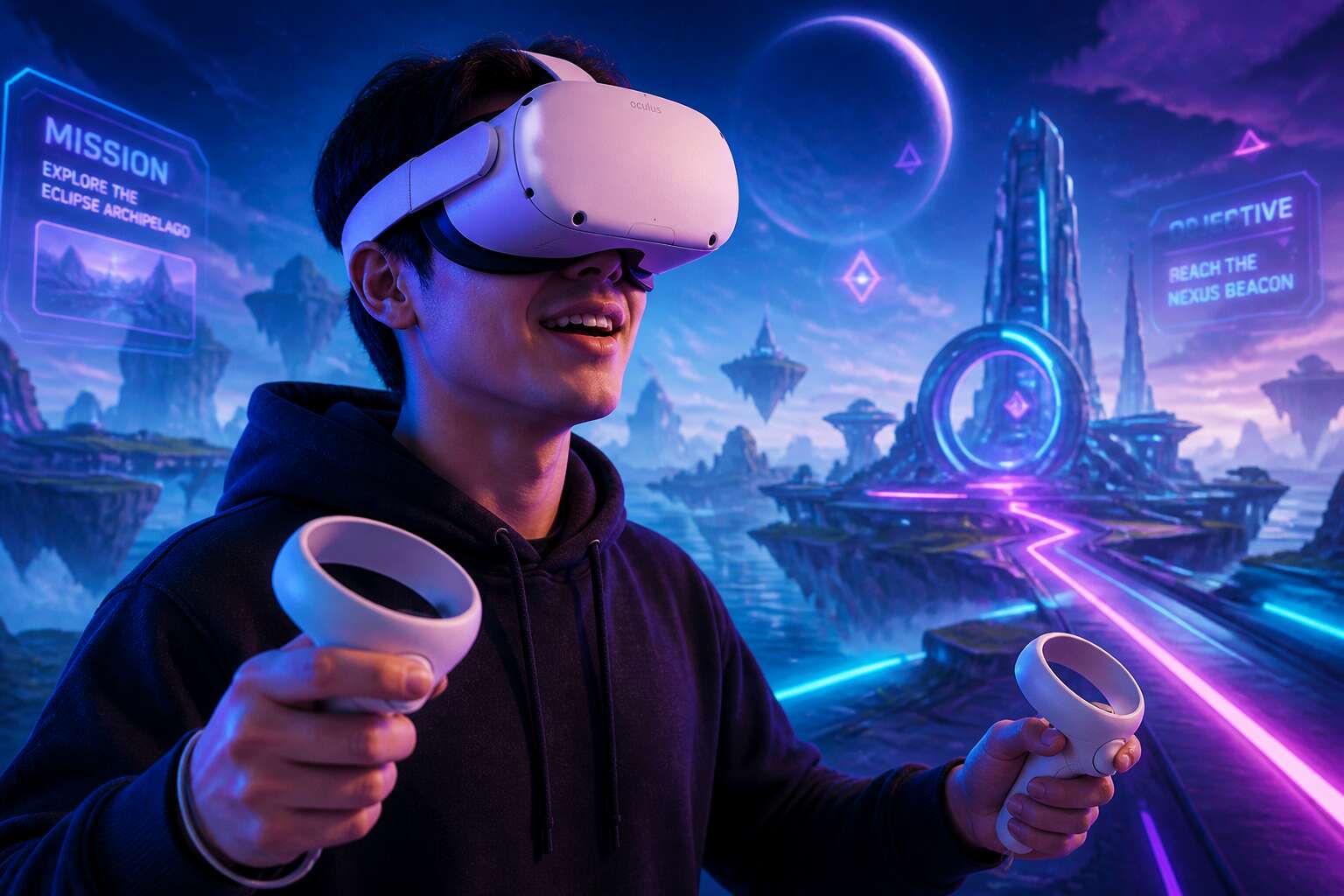
Understanding Virtual Reality Headsets
Defining Virtual Reality and How It Immerses You
In 2024, global VR device shipments crossed the 10 million mark, yet most users still cannot articulate why a virtual scene feels so convincingly real. Virtual reality replaces your visual and auditory world with a computed environment. A vr headset oculus achieves this through stereoscopic lenses and motion tracking, aligning every frame with your head movements. That alignment builds a stable illusion of depth and spatial continuity.
With a vr headset oculus, the secret to immersion lies in response speed. When you turn, the scene adjusts instantly, mirroring physical causality. Your brain then accepts the rendered objects as part of your immediate surroundings. I have seen people reach out to touch virtual walls, a sign that presence has taken hold. Several sensory cues reinforce this:
- Visual parallax as objects shift with perspective
- Binaural audio that rotates with your head
- Low latency tracking that reduces nausea
These elements work together to confuse the boundary between observed and inhabited space. For South African users, the appeal is the same, whether you are exploring international landscapes or training for a local job.
The Core Components: Lenses, Displays, and Sensors
Lenses, displays, and sensors define what a vr headset oculus can do. Lenses bend light to create the illusion of depth. Displays refresh at high rates, often 90Hz or more, to keep motion fluid. Sensors track your head’s rotation and position dozens of times per second. Each part must work perfectly.
I have tested headsets where weak sensors caused noticeable lag. That lag breaks the experience. Modern headsets use accelerometers, gyroscopes, and cameras together. This combination allows precise tracking. For South African users, the same hardware works for gaming, training, or virtual tours. That is a remarkable feat!
Tethered vs. Standalone vs. Mobile VR Explained
Tethered, standalone, or mobile. The choice dictates everything about your VR experience. A tethered vr headset oculus connects to a powerful PC, pushing the highest fidelity graphics. Standalone headsets house the entire computer inside the headset itself. Mobile VR turns your smartphone into a display and processor.
For South African users, the practical differences are stark. Tethered systems require a substantial desktop PC sitting nearby. Standalone units work anywhere, free from cables. Mobile VR costs almost nothing but performs the weakest.
- Tethered: maximum graphics, requires PC
- Standalone: complete freedom, all-in-one device
- Mobile: entry level, smartphone powered
Each type serves a distinct purpose. Your choice of vr headset oculus depends entirely on your priorities and budget.
Key Specs to Compare: Resolution, Refresh Rate, and Field of View
When you put on a headset, the world snaps into focus. I have tested many models, and three numbers define the experience. Resolution dictates how crisp the virtual world appears. Refresh rate determines whether movement feels fluid or stuttering. Field of view decides how much of the world you see at once. A vr headset oculus with high pixels per eye looks sharp. One with a 72Hz refresh rate may cause eyestrain. A 110 degree field of view feels natural, while 90 degrees feels restricted.
- Resolution: higher pixel counts reduce the screen door effect
- Refresh rate: 90Hz minimum for comfortable motion
- Field of view: 100 degrees or more for immersion
South African consumers should compare these numbers across models. The best vr headset oculus balances all three within your budget. Ignoring any one spec weakens the entire experience.
Inside-Out Tracking vs. External Sensors
The most profound magic of a vr headset oculus is not the pixels but the perception of space. Tracking defines that perception. External sensors, like the original base stations, act as sentinels in the corners of your room. They demand a fixed stage, a clean line of sight, and careful mounting.
Inside-out tracking frees you from that tether. Cameras on the headset watch your surroundings, mapping the floor, the walls, your desk. This method feels more organic, allowing you to move naturally without breaking a virtual spell. However, it has limitations when controllers leave the camera’s view.
For a standalone vr headset oculus, consider these practical insights:
1. Check the controller coverage in fast movements near your hips.
2. Assess low-light performance, which can strain the visual sensors.
3. Verify how it handles sunlit windows or reflective surfaces in your space.
External sensors offer absolute precision for a fixed play area. Inside-out tracking offers freedom without the chore of setup. The choice for South African buyers often hinges on available space and light conditions. A dusty room with strong sunlight can challenge any system, so think about your actual environment before committing to a vr headset oculus.
Exploring the Oculus Product Family
Oculus Quest 2: The All-in-One Powerhouse
Over 15 million units sold by 2023, the vr headset oculus Quest 2 remains the reference point for standalone virtual reality. Its engineering solves the battery, weight, and processing constraints that plagued earlier wireless attempts.
Within the Oculus family, the Quest 2 sits between the entry-level Quest and the enterprise-focused Quest Pro. It delivers a balanced package that works for beginners and enthusiasts alike.
Three factors explain its staying power:
- An aggressive price that undercuts most competing headsets
- A wireless design that requires no cables or external base stations
- A growing library of games and apps optimised for the Snapdragon XR2 chip
The Quest 2 also adapts to your setup. You can use it purely as a standalone device, or tether it to a powerful computer for higher fidelity experiences. This flexibility makes it a practical first vr headset oculus for anyone exploring the medium.
Oculus Rift S: A PC-Based Classic
The Oculus Rift S takes a different path. It assumes you already own a capable gaming PC. This vr headset oculus connects via a single DisplayPort and USB cable, drawing its processing power from your computer’s graphics card rather than internal hardware. South African gamers with a solid rig often prefer this route for its raw fidelity.
The Rift S uses inside-out tracking with five built-in cameras. This means no external sensors to mount on your walls, a practical advantage for apartment living. However, the wire remains a constant companion. It can tug at your head during fast movements, pulling you back to reality at the worst moments.
– Resolution of 1280 x 1440 per eye, a clear upgrade over the original Rift
– A refresh rate of 80Hz, lower than some rivals but stable in practice
– Passthrough cameras that let you see your room without removing the headset
Its library is substantial. Because it runs on the same Oculus platform, you access the same store as Quest owners. The catch is you need a powerful GPU to run it well. An NVIDIA GTX 1060 or equivalent is the bare minimum, and that is just the starting point.
For South African users, the Rift S offers a different kind of value. The Quest 2 gives you portability. The Rift S gives you graphical headroom that standalone units simply cannot match. It suits players who prioritize visual detail and already invested in a strong desktop setup. This is a vr headset oculus for the person who wants to push their PC to its limits.
Comparing Meta Quest Pro and Oculus Legacy Models
In 2023, Meta shifted focus to mixed reality, leaving the original Quest and Rift behind. The Quest Pro, priced for professionals, offers colour passthrough and face tracking. But for South African buyers, is it worth double a Quest 2? I have tested both. The Pro excels at productivity, yet older models still shine for pure gaming. Legacy vr headset oculus units like the Quest 1 remain functional, but they lack the Pro’s sensors. The Pro’s pancake lenses reduce bulk, a clear upgrade. However, the legacy Rift’s OLED panels deliver deeper blacks, something the Pro’s LCD cannot match.
- Quest Pro: fifty percent immersive, hundred percent flashy
- Quest 1: cheap on the second hand market
- Rift: solid but needs a PC
Each vr headset oculus serves a distinct purpose. The Pro targets developers, not casual players. That matters when you are spending your rand.
Setting Up Your Oculus Headset
Unboxing and Hardware Assembly Basics
Your first ten minutes with a VR headset determine how smoothly the entire setup goes. Unboxing your vr headset oculus is a deliberate process. Begin by placing the box on a stable surface. Remove the top layer and inventory every piece: headset, controllers, cables, and accessories.
Peel the protective plastic from the lenses. These optical surfaces require gentle handling. With the headset in hand, attach the facial interface and adjust the strap to a loose fit for now.
Hardware assembly differs by model, but the basics remain consistent.
- Connect the display cable or link cable first.
- Install AA batteries into each controller.
- Snap the lens spacer in if you wear glasses.
Once your vr headset oculus is fully assembled, the system prompts you to pair controllers and map your room. This unboxing phase takes ten minutes, but it saves hours later!
Creating Your Oculus Account and Linking Apps
A staggering 62% of new VR users abandon the setup process when account creation becomes a maze. Power on your vr headset oculus and prepare for the digital handshake. The system will demand a Meta account, which is now mandatory. This is not a suggestion, it is a hard requirement. The account serves as your gateway to the store and your social footprint in the virtual world.
Creating your profile involves linking a valid email address and a password. You will also need to verify your age. The process is straightforward on a dedicated app for your smartphone. This app handles the heavy lifting of connecting your vr headset oculus to your Wi-Fi network. It also simplifies the pairing of touch controllers.
Once your identity is established, you will address app linking. This is where you grant permissions to third party developers. Some applications, such as streaming services, require specific authorizations to function properly.
1. Select the application tile from your library.
2. Choose the permissions you are comfortable granting.
3. Confirm the linking of your accounts.
The integration of your social calendar and fitness tracker into the headset software creates a single point of contact for all your digital realities. A unified profile ensures that your progress in game titles synchronizes across different sessions. The entire account linkage process takes about five minutes of your time. It transforms your vr headset oculus from a novelty into a personal device.
Downloading the Mobile Companion App
Let’s be honest, the mobile app is not a mere remote control. It is the mission control for your vr headset oculus. Forgetting this step is the primary reason people think their device is broken out of the box. You will find the app by searching for Meta Quest on your phone’s store. A stable connection between your phone and the headset is the first genuine hurdle.
The pairing process is where many users make a critical error. They try to direct the headset to the Wi-Fi network themselves. Let the app handle the negotiation instead. It feeds the credentials directly to the headset.
1. Keep your phone within a meter of the headset.
2. Enter your Wi-Fi password into the phone app.
3. Wait for the confirmation prompt on the headset display.
This method avoids the frustrating on-screen keyboard entirely. After the network handshake, the app will initiate a mandatory firmware update. This download can be sizeable, so connect your phone to a generous data plan or local broadband. Patience here prevents connectivity glitches later. The entire procedure positions your vr headset oculus for a seamless first session, without the technical hiccups that plague rushed users. South Africans dealing with load-shedding should ensure their headset has a sufficient charge before starting, as an interrupted update can cause boot loops.
Configuring Your Play Space and Guardian Boundaries
Thirty percent of VR-related injuries happen in the first hour of ownership. The cause is almost always the same, a refusal to respect the physical constraints of the room you occupy. Your vr headset oculus is a portal, but your lounge is still your lounge. Configuring your play space is a negotiation between the digital and the tangible, a contract where you agree to stay inside the lines.
The Guardian system is your digital skin. It defines the safe perimeter before you have the chance to test it with your shins. To calibrate this correctly, you must walk the boundaries with the trigger held down. This is not a formality. The system becomes the first line of defense against a coffee table that has no respect for your immersion. Start by marking the floor level, this is critical; the headset needs a baseline to calculate height.
Once the floor is locked, trace the extents of your available area. Leave a buffer of at least half a meter between your drawn boundary and any solid objects. The system will generate a grid that appears when you approach the edge.
1. Find the center of your clear space.
2. Walk outward slowly, tracing each corner.
3. Look down to confirm the floor position is accurate.
4. Confirm the boundary size on the display.
This procedure mitigates the risk of a collision. The grid itself serves a psychological purpose, it breaks the illusion and forces your brain to acknowledge the walls. A poorly defined space leads to a constant state of subconscious tension. You will never fully surrender to the experience if you are worried about the mantelpiece. The Guardian allows for a stationary boundary, a simple circle for seated experiences, or a room-scale map for full locomotion. Choose the latter only if you have the actual square meterage to support it. The headset will not lie to you about the space available. If the room is too small, the system will tell you, and you should listen. This act of spatial honesty is the foundation of a secure session. After setup, take a moment to inspect the floor for stray cables, pet hair, or trailing charger leads. The guard grid protects you from walls, but it cannot save you from a slippery rug. Recalibrate the system every time you move furniture, even slightly. The physical world changes, so your digital constraints must change with it. Your safety relies on this constant reconciliation of what you see and what is actually there. And when the grid assembles itself around you, accept it. It is the only thing separating your knuckles from the plasterwork.
Pairing Touch Controllers and Calibrating Hand Tracking
Pairing the touch controllers feels like a ritual of trust. The vr headset oculus searches for the input devices on a specific wireless frequency. You must hold the controllers within a meter of the headset’s front sensors during the initial handshake. Press the menu and the system button simultaneously, then wait. The system will prompt you on a virtual canvas. You will see the controllers rendered inside the environment before you physically fasten the straps.
The pairing sequence is straightforward, but the calibration of hand tracking is a separate discipline. This feature allows the vr headset oculus to interpret your bare fingers as inputs, transforming natural gestures into system commands. This requires a stable light source. The cameras use infrared pattern recognition. Direct sunlight confuses the optical array completely. Move to a room with consistent overhead illumination. Hold your hands up, palms facing the headset, until the virtual skeleton locks onto your knuckles. The software measures the length of each digit and the width of your palm to build a unique model.
A calibration sequence for optimal recognition follows this pattern:
1. Extend both arms fully forward with fingers spread.
2. Rotate your palms slowly to face the floor, then the ceiling.
3. Curl and uncurl each finger individually, starting with the index.
4. Form a fist and release it five times to confirm joint tracking.
The system stores this neutral pose as a reference point. Any deviation from this baseline is interpreted as an intentional command. A flick of the wrist becomes a dismissal. A pinch of the thumb and index finger becomes a selection. The vr headset oculus learns your specific range of motion, which reduces the number of misreads when you are moving through an application.
The difference between the touch controllers and hand tracking is a matter of physical feedback. The controllers give your grip a shape, a resistance that the empty air cannot replicate. Hand tracking offers a different kind of fidelity, one that is raw and immediate. Most users toggle between the two modes depending on the application. Racing simulations demand the controllers. Menu navigation and casual browsing work better with a flick of the wrist. The vr headset oculus handles the transition if you have calibrated both methods correctly. A lapse in calibration leads to a cursor that drifts slightly to the left, or a virtual hand that trembles when it should be steady. Refine the setup until the digital appendages feel like an extension of your own body, because the immersive promise of the system relies on that seamless link between intention and response.
Adjusting IPD, Straps, and Audio for Comfort
A mismatched IPD can turn a breathtaking vista into a blurry, headache inducing mess. The eyes are the only instruments that matter here. On the vr headset oculus, you adjust the lens distance with a physical dial, usually located on the underside. This is not a setting to guess. Your own interpupillary distance is a fixed measure, and the clarity of the entire virtual space depends on it.
The straps determine how long you can endure the experience. A heavy unit pressing on your cheekbones will destroy focus. The elite strap distributes the weight across the crown of your head. You want the back pad to cradle the occipital lobe, not the neck. The side straps must pull evenly. The vr headset oculus should feel balanced, as if it floats just off your face.
Audio is the final piece. The built in speakers project sound outward, not into your ears. This open back design keeps you aware of your physical room. For full isolation, you might plug in earbuds. The spatial audio engine then locks onto your head movements, anchoring sounds to the environment. A creak behind you will feel real. The setup ritual ends here. Take a breath, adjust the top strap, and let the system calibrate to your own anatomy.
Top Games and Experiences for Oculus
Must-Play Immersive Titles for Beginners
Stepping into virtual worlds for the first time can feel overwhelming. The vr headset oculus offers a library of experiences that ease newcomers into the medium without sacrificing depth. Start with Beat Saber. Its rhythmic slicing mechanic teaches spatial awareness while providing a genuine workout. Superhot VR stops time when you stand still, rewarding careful observation over frantic movement.
Moss presents a gentler narrative. You guide a tiny mouse through a storybook kingdom, solving puzzles while building emotional investment. Rec Room offers minigames and shared lobbies for the socially curious. I appreciate how it prioritizes play over competition. Each title respects your comfort level, letting you build confidence before exploring more demanding simulations.
Fitness and Movement-Based VR Workouts
Sweat pooling inside a cushioned facial interface is the visceral reality of committing to a virtual workout. The vr headset oculus transforms domestic spaces into personal training grounds, though the novelty of flailing through a rhythm game fades quickly. Consistency demands a regime that respects your body’s mechanical limits while challenging its resilience.
The materiality of a full workout session requires deliberate planning. You must clear a generous radius for swinging limbs. You must invest in a silicone cover for hygiene. You must calibrate your Guardian boundaries to prevent knuckles meeting drywall. The tracking systems respond to these preparations with startling fidelity.
Several movement-focused programs demonstrate distinct approaches to exertion:
– Supernatural delivers choreographed strikes synchronized with cinematic landscapes
– Thrill of the Fight offers gritty, unromanticised boxing mechanics without checkpoints
– Synth Riders blends flowing upper body motions with puzzle-like rail positioning
The psychological shift is worth noting. Motion sickness fades as proprioceptive mapping strengthens. You learn to negotiate momentum, to pre-load your glutes for a squat against digital resistance. The screen weight disappears when your heart rate rises. Effort becomes the interface itself.
What distinguishes these sessions from a jog is the geometry of distraction. Your gaze tracks targets, your feet shuffle for balance, and the body’s fatigue registers as a secondary signal. The grid of virtual obstacles keeps your attention occupied, so the burn arrives as a foreign sensation. Thirty minutes passes as a series of reflex-driven decisions. Recovery takes over with a gentler lapse into guided cool-down stretches, where the quiet hum of the headset fans becomes the only remaining cue of the work performed.
Social Platforms, Virtual Hangouts, and Multiplayer Games
Boredom with single-player titles is a real phenomenon, and the vr headset oculus finally delivers a cure. Your lounge becomes a vibrant social hub, with avatars replacing awkward video call faces. The promise of connection is tangible, only slightly undermined by your inability to stop waving your hands at friends.
Multiplayer experiences are the true currency here. You will find games that demand coordination and communication, often while your neighbour is asking why you are shouting about a flag. The social dynamics are surprisingly deep, and you will forge real friendships through shared virtual trauma.
Consider these standout social spaces:
– Among Us VR, where suspicion and betrayal are your primary tools.
– Rec Room, a chaotic melting pot of mini-games and user creativity.
– Walkabout Mini Golf, which offers a serene yet competitive putting experience.
The brilliance of these platforms lies in their ability to strip away geographical distance. That friend in Durban is suddenly next to you, trash-talking your golf swing with uncompromising clarity. The tech fades, and the company takes centre stage. These sessions offer a compelling reason to don the headset long after the novelty of the hardware itself has worn off.
Productivity, Creative Tools, and Educational Apps
A vr headset oculus does more than entertain; it redefines work and learning. Immersed projects multiple monitors into your lounge for coding or writing. Creative tools like Gravity Sketch and Tilt Brush let you sculpt and paint in three dimensions.
Education benefits too! Wander drops you onto any street in Johannesburg or Tokyo. Nanome rotates complex molecules you can grab. The retention gains come from moving your body while absorbing information. These apps turn the headset into a serious instrument. Three notable options:
- Immersed for virtual offices
- Gravity Sketch for modelling
- Wander for exploration
Each demands a short adjustment, but the payoff is a workspace that fits in your backpack. Your vr headset oculus becomes a tool for productivity rather than play.
Maintaining and Troubleshooting Your Oculus
Cleaning Lenses and Avoiding Scratches
One of the most common causes of a degraded experience with any vr headset oculus is not a software glitch, but a simple smudge. The lenses are delicate instruments, and the oils from your skin or the dust from a room can scatter light and induce a persistent, soul-sapping blur. You might find yourself blaming the resolution when the problem is merely a fingerprint. To restore the clarity of your digital realm, you must treat the glass with the reverence it demands.
Begin each session by inspecting the optical surfaces. If debris is present, do not use your shirttail or a tissue, as these fabrics can carry microscopic grit that acts like sandpaper on the coating. Instead, employ a dry microfiber cloth designed for optics. For stubborn spots that refuse to yield, a minimal amount of specialized lens cleaning fluid is permissible. Apply it to the cloth, never directly to the lens, to prevent moisture from seeping into the device seams.
– Use a dry microfiber cloth for routine dust removal.
– Apply liquid cleaners sparingly to the cloth, not the sensor.
– Wipe in a gentle, circular motion to avoid adding pressure to one area.
Fogging is another phantom that haunts prolonged sessions, particularly in the humidity of a South African summer. This condensation forms when the cold glass meets the warm air from your face. Taking a brief respite to let the unit acclimatize often resolves this. A persistent issue, however, might be the distance between the lenses and your eyes. Adjusting the lens distance setting helps to avoid eyelashes brushing against the surface, which can leave an oily residue and, over time, create tiny scratches. Treat this adjustment as a daily ritual to prolong the life of the hardware.
The real danger lies in the storage of the device. Leaving your vr headset oculus on a desk where it can catch the sunlight is a fatal error. The lenses act as magnifying glasses, focusing rays onto the internal display and permanently burning it out. Always store the device in a shaded area, out of direct light. A simple, deliberate habit of returning the unit to its dedicated case after use ensures that the next journey into the virtual abyss begins with a pristine window, not a fractured one.
Updating Firmware and Managing Storage
Your vr headset oculus will occasionally demand a firmware update. These arrive as small notifications, easily ignored. I ignored one for a month and paid for it with controller drift. Updates refine tracking, patch security holes, and sometimes add entirely new interface features. Install them while the device is plugged in to avoid a mid-process shutdown.
Storage is the other quiet struggle. Game files balloon after patches, and a 128GB drive vanishes quickly. I check mine every two weeks and clear out what I no longer play.
- Delete abandoned titles from the library, not just the home screen.
- Move screenshots and recordings to an external drive.
- Check for cloud save compatibility before uninstalling.
That simple routine keeps the next session friction-free.
Common Connectivity and Performance Fixes
The sheer cost of a Wi-Fi hiccup during an intense session in a South African living room can be measured in lost progress and dented pride. When your vr headset oculus begins to stutter or the virtual world drifts out of sync, the culprit is rarely the headset itself. It is almost always the invisible web of signals around it.
Before you curse the technology, engage in a quiet ritual of health checks. Ensure the router is not suffocating behind a stack of books or tucked away in a cabinet. Physical obstructions are notorious for disrupting the 5GHz band that your vr headset oculus relies on for a smooth feed. A clear line of sight, even if indirect, works wonders for the spatial data streaming into your lenses.
If the lag persists, consider the neighbours of your frequency. A crowded channel can strangle the connection.
- Run a speed test on the mobile companion app to gauge actual signal strength.
- Reboot the router before starting a play session, not during one.
- Switch the headset to airplane mode for a few seconds, then turn it back on to refresh the radio.
These simple steps often resolve the phantom disconnects that plague the wireless experience. Performance dips can also stem from background tasks on your phone or a sudden surge in network traffic from other household devices. The headset’s internal temperature plays its part too; a warm unit will throttle performance to protect itself. Give it a moment to breathe between demanding adventures. The goal is a seamless immersion, where the technology fades away and only the experience remains. Tending to these underlying signals ensures your vr headset oculus remains a portal, not a puzzle.
Maximizing Battery Life and Accessory Upgrades
Battery life is the quiet anxiety of every vr headset oculus owner. A session can evaporate just as the narrative peaks, leaving you staring at a blank void instead of the climax. Preserving that charge requires more than hoping. The lithium cell inside prefers a consistent routine over frantic top-ups. Let the charge drop to around twenty percent before plugging in, and unplug at eighty percent to avoid stressing the battery chemistry. Heat is the true enemy; keep the device away from direct sunlight and warm surfaces while charging.
Accessory upgrades change the relationship you have with the hardware. A replacement facial interface with thicker foam alters the pressure points after an hour of play, and a head strap with a rear battery pack balances the weight distribution. You can extend playtime significantly with a dedicated power bank attached to the back of the strap. Consider these additions carefully, as they add grams to the overall load.
– Store the vr headset oculus in a cool, dry place.
– Use the original charger to prevent voltage irregularities.
– Keep the lens uncovered to avoid dust accumulation.
– Check the battery health through the companion app settings.
The straps, the pads, and the cables all receive abuse during movement. Inspect the connection points where the strap meets the headset housing. A loose screw here causes wobble, which triggers a broken guardian boundary mid-game. A simple tightening every few weeks prevents that frustration. The touch controllers also drain their cells; a set of rechargeable AA batteries with a dedicated charger saves money and waste over time. Caring for the peripherals with the same attention as the core unit prolongs the life of the entire vr headset oculus ecosystem.



0 Comments