
Virtual Reality Explained
What VR Is at Its Core
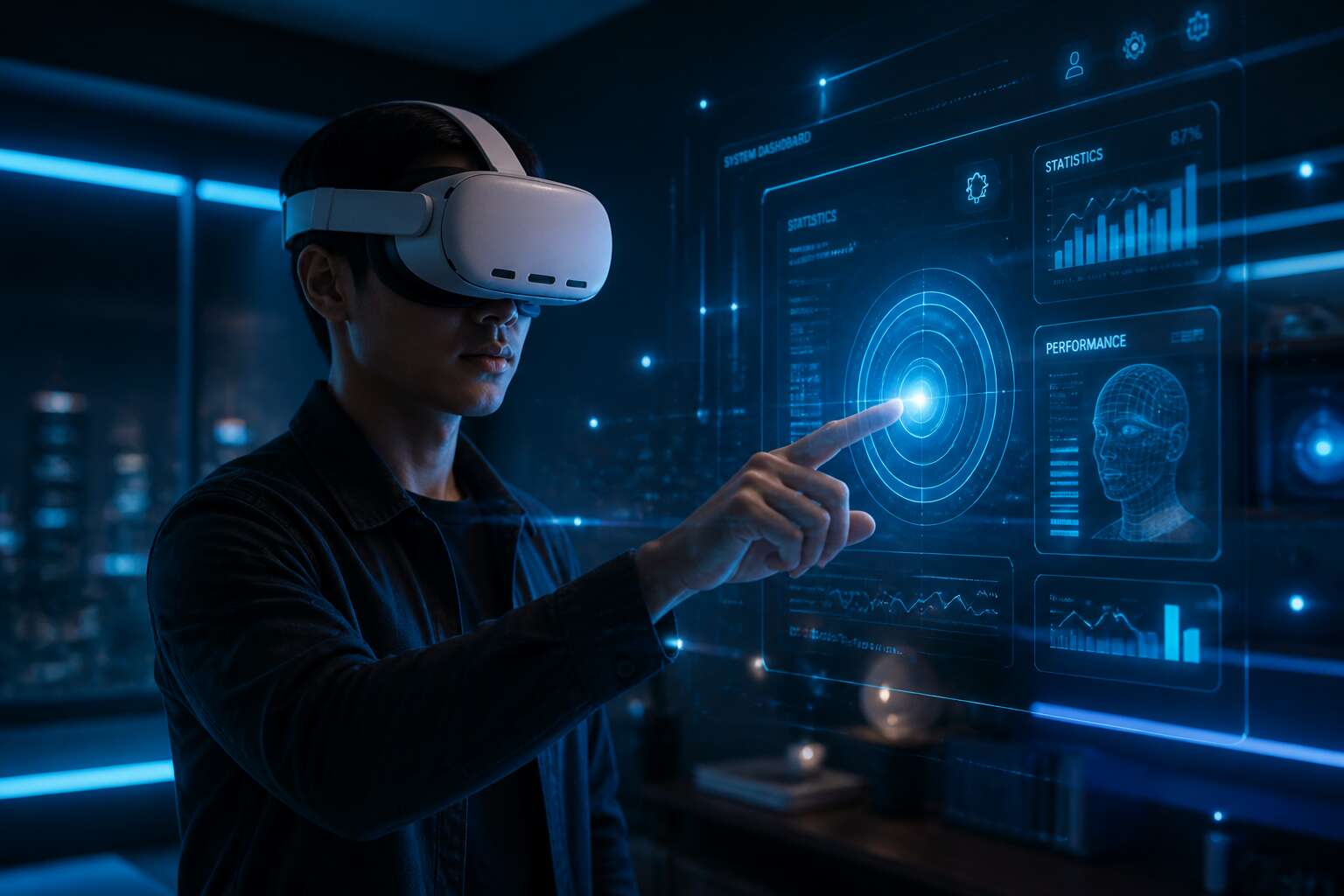
Imagine stepping inside a world made of pure data! That is the promise of virtual reality technology. At its core, VR replaces your physical surroundings with a computer generated environment. Sensors track your head and hands. Displays adjust pixels in real time. Audio arrives from every direction. Your brain accepts this synthetic domain as real, creating presence.
To understand what is virtual reality technology, consider its building blocks:
- Head mounted displays for visual immersion
- Motion tracking for spatial awareness
- Haptic feedback for tactile touch
These elements respond together. The result is not a passive screen. It is an interactive space where you act and explore. In South Africa, VR now serves medical training, mining simulation, and architecture. The principle stays simple: digital simulation that convinces your body to accept another place as your own.
Key Characteristics of Immersive Environments
Immersive environments succeed when they convince your senses without asking for permission. Field of view stretches beyond your peripheral vision. Stereoscopic depth places virtual objects at believable distances. A reactive world mirrors your movements in milliseconds. This is what is virtual reality technology achieving when it works well. It erases the boundary between intention and action!
Consider how a polished simulation behaves:
- Scale remains consistent whether you stand near or far from an object
- Audio shifts with head position, anchoring sound in space
- Virtual objects respond to touch, weight, and force
These traits separate a passive recording from a lived moment. In South African mining, medical, and architectural training, the environment must hold up under scrutiny. A flickering wall or a delayed shadow ruins the experience instantly.
When someone asks me what is virtual reality technology, the answer is in these details. The technology matters less than the coherence of the world it builds.
Virtual vs. Augmented vs. Mixed Reality
Virtual reality replaces your entire field of view with a simulated world. Augmented reality, by contrast, layers digital information onto the physical space around you. Picture a mine engineer in the Northern Cape reading real-time geological data projected onto the rock face before them. That is AR in action.
Mixed reality combines elements of both. It anchors virtual objects into your actual environment, so a training technician can manipulate a holographic pump while still seeing their own hands. The distinction matters when you ask what is virtual reality technology versus its siblings, because each tool solves a different problem.
- VR: full immersion, no visual connection to the physical world
- AR: digital overlays on real surroundings
- MR: interactive hybrid where virtual and physical objects coexist
In my experience, South African architecture firms and medical faculties choose based on the task, not the novelty!
How VR Technology Delivers Immersion
Head-Mounted Display Technology
Putting on a head mounted display immediately replaces your field of view. Tiny sensors track your head’s rotation and translate that motion into a new perspective. The frame rate stays above 90 hertz, which keeps the image stable even when you turn quickly. I have seen first time users physically flinch when a virtual object passes near them!
- High refresh rate displays that eliminate flicker
- Low latency inertial sensors for accurate tracking
- Adjustable lenses that match your eyesight
For South African readers exploring what is virtual reality technology, the headset is not the entire story. The immersion emerges from how quickly the system responds to your body’s smallest movements.
Motion Tracking and Spatial Awareness
Motion tracking is the mechanism behind every convincing virtual scene. Sensors capture your lean, your step, your glance. The system converts that data into spatial awareness, allowing you to circle a digital object with accurate depth perception. In South Africa, where vast landscapes often dwarf the observer, moving through a fabricated space carries a particular resonance.
Your body responds before reason intervenes. The room fades. The floor remains. What is virtual reality technology if not a negotiation between muscles and machine predictions? A single step becomes a measured gesture. A tilt of the head shifts the horizon. This feedback loop, executed in milliseconds, separates a convincing illusion from a static image.
Spatial Audio and Haptic Feedback
Spatial audio works by tricking the vestibular system as much as the ears. Each sound arrives with timing, phase, and spectral cues that mimic real-world acoustics. The brain constructs a three-dimensional soundscape from these signals. You hear a footstep behind you and your neck tenses before you consciously locate the source. The effect is immediate.
Haptic feedback completes the illusion through touch. Haptics deliver texture, resistance, and impact sensations directly to the skin. Modern systems pair several tactile channels:
- Vibrotactile actuators in headset straps vibrate with each simulated movement.
- Haptic gloves apply resistance to fingers as you grip virtual objects.
- Pressure vests register impacts like collisions or a hand placed on your back.
What is virtual reality technology, then, if not a careful orchestration of sensory inputs? The most convincing systems calibrate sound, touch, and vision to match your physical expectations. Your body willingly suspends disbelief.
Graphics Rendering and Frame Rates
Frame rate determines whether your brain accepts the virtual scene as real. Flat screen viewers tolerate 30 frames per second. VR cannot. A head turn with a 20 millisecond image lag sets your inner ear against your eyes. Nausea follows. High-end headsets render at 90Hz or 120Hz to keep the brain convinced. The question of what is virtual reality technology, at its most practical level, comes down to this: delivering the right pixels at the right moment.
Resolution matters, but raw pixel counts fail when the render pipeline stalls. Foveated rendering tracks your gaze and sharpens only the focal point, so peripheral vision receives less detail without the user noticing. Reprojection predicts head movement to generate in-between frames, smoothing motion without doubling the GPU workload.
Developers balance refresh rate, render resolution, and post-processing against the hardware budget. Break that balance and the illusion collapses. You are back in your living room.
Essential Hardware and Systems
VR Headsets: Tethered, Standalone, and Mobile
Choosing a headset hinges on the trade-off between freedom and power. Tethered headsets plug into a gaming PC or console, unlocking the highest visual fidelity and complex simulations. Standalone headsets carry their own processors, offering portability without a wire. Mobile headsets, meanwhile, use a phone as the brain and screen, making them an accessible entry point.
In South Africa, I have watched the standalone category overtake the others in popularity. The practical differences matter:
- Tethered units demand a hefty upfront investment, but they deliver unrivaled performance.
- Standalone models balance convenience and capability, ideal for quick sessions.
- Mobile adapters cost little, yet limit immersion to basic 360-degree video.
Understanding what is virtual reality technology requires recognising that the headset is only one component; the system behind it shapes the depth of every experience. That depth keeps expanding!
Input Devices: Controllers, Gloves, and Full-Body Suits
Controllers are the standard. They translate hand movements into digital actions with satisfying precision. Gloves go further, capturing finger bends and subtle gestures. Full-body suits remain the domain of enthusiasts and research labs. They track your legs, torso, and posture, which sounds glamorous until you realise you are wearing a garment that looks like a wetsuit designed by an IT department. Understanding what is virtual reality technology means accepting that the headset is just the window. These input devices are the hands, and sometimes the feet. In South Africa, glove and suit adoption grows slowly due to cost and limited local support. Controllers dominate, for good reason.
– They work with every major headset.
– They require no calibration ritual.
– They survive clumsy swings.
The hierarchy is clear: controllers for practical immersion, gloves for finer control, suits for total commitment. Choose accordingly.
Tracking Systems: Inside-Out vs. Outside-In
Tracking systems decide whether your virtual environment feels anchored or shaky. Outside-in tracking uses external sensors placed around the room. They watch your headset and controllers from fixed points, delivering sub-millimetre precision. Inside-out tracking reverses the logic. Cameras on the headset scan your surroundings as you move. No external equipment, no elaborate setup, just freedom. This simplicity made inside-out the default for many modern headsets, a practical gain in South African homes where permanent sensor mounts rarely make sense.
What is virtual reality technology without dependable tracking? It is a screen strapped to your face, nothing more. Part of understanding what is virtual reality technology is recognising that the headset is only half the story. Outside-in places you centre stage under watching lights. Inside-out hands you the torch and lets you wander. Neither wins outright. The right choice depends on room size, budget, and the experiences you chase. Most home users find inside-out sufficient. Enthusiasts chasing every subtle movement still prefer outside-in.
Room-Scale VR and Play Spaces
When asking what is virtual reality technology, the hardware that runs the experience matters as much as the headset. A capable graphics card, a compatible processor, enough RAM, and a steady power supply form the core setup for smooth frames. Many headsets also require specific ports for video output and data.
For room-scale VR, you need empty floor space, usually around two by two meters, but bigger is better. Clear away coffee tables, rugs, and anywhere you might trip. Once the boundary is drawn, the system will let you know when you approach a wall.
- Keep cables off the walking path
- Set the boundary away from windows and hard edges
- Use a central mat to help you stay oriented
Understanding what is virtual reality technology includes knowing how the software checks your play area. Some systems let you stand or sit, others demand room-scale. I prefer a visible grid so I never bump a bookshelf while reaching for a phantom object!
Selecting the Right VR Setup
Selecting the right VR setup starts with asking what is virtual reality technology actually demanding of your hardware. A tethered headset leans on a desktop system with serious processing power, while a standalone unit contains its own processors inside the frame. Neither option is objectively superior. The correct choice depends on how you intend to move, create, and play.
Consider your space and habits. A fixed room with clear floors suits a high performance rig. A busy household or frequent travel calls for something lighter. I have found that the recommended specifications from each manufacturer offer a reliable baseline, but future software tends to demand more over time.
- The headset’s connection standard must match your graphics card outputs
- Wireless streaming demands a router capable of low latency at high bandwidth
- Future software releases often require more headroom than current ones
Understanding what is virtual reality technology also means accepting that hardware choices shape the experience. The right setup stays out of the way. The wrong one becomes a constant reminder of limits.
Practical Applications Across Industries
Gaming and Immersive Entertainment
Global spending on VR entertainment hit $7.2 billion in 2024. Yet the real impact is how this technology reshapes the way we play and watch. In gaming, virtual reality places you inside the action. You are not controlling a character. You are the character. This shift creates a level of immersion that flat screens cannot match.
- VR arcades in Johannesburg and Cape Town offer social play sessions
- Competitive esports leagues broadcast matches from virtual arenas
- Interactive film experiences let viewers choose their own path
These examples show why understanding what is virtual reality technology matters for the entertainment sector. I have watched developers pivot their entire design process to focus on social presence and emotional engagement. Concerts and festivals use VR to let fans watch from the front row, regardless of their physical location. The result is a new economy of shared digital experiences!
Professional and Vocational Training
At a Free State mining complex, new operators strap on headsets to rehearse underground rescue procedures before boarding a cage. High risk industries use virtual reality to convert potentially fatal mistakes into learning opportunities. This is what is virtual reality technology doing for professional training: building competence without consequences.
Medical residents in Cape Town practice delicate procedures on virtual cadavers. Aviation technicians at OR Tambo dismantle and reassemble jet engines in immersive space. Each session generates performance metrics that trainers analyse to adjust instruction for individual learners.
- Emergency response drills for refinery workers
- Welding practice for boiler makers
- Patient intake scenarios for nursing students
In my work with vocational programmes, I have watched these repetitions build fluency that classroom theory cannot replicate. Employees arrive on site with hundreds of virtual repetitions behind them. That is what is virtual reality technology achieving for professional readiness.
Healthcare Therapy and Rehabilitation
In rehabilitation units across South Africa, stroke survivors don headsets to rebuild neural pathways through repetitive, immersive exercises. Therapists programme scenarios that reward small movements, turning monotonous physiotherapy into engaging tasks. What is virtual reality technology offering these patients? A measurable, adaptive environment where progress is tracked in real time.
PTSD treatment uses controlled exposure therapy, letting patients confront triggering situations with a clinician present. Chronic pain management benefits from distraction-based interventions that shift focus away from discomfort. Common applications include:
- Balance and gait training for older adults
- Upper limb motor recovery after spinal injury
- Anxiety reduction during wound care procedures
Each session generates objective data that guides clinical decisions, making what is virtual reality technology a practical extension of therapeutic practice rather than a novelty.
Education and Virtual Learning Environments
Beyond clinical settings, what is virtual reality technology doing for education? It transforms abstract concepts into tangible experiences! A geography student in Johannesburg can traverse the Karoo’s geological layers without leaving the classroom. Medical trainees at Stellenbosch practice surgical procedures on virtual cadavers, repeating steps until muscle memory forms.
Virtual learning environments also bridge resource gaps across South Africa.
- History classes revisit Soweto 1976 through spatial recreations
- Engineering students assemble machinery with force feedback
- Language learners converse with AI avatars in real time
These tools shift passive reading into active discovery, giving every learner access to expensive laboratories and field sites.
Real Estate and Architectural Visualization
In South African real estate, what is virtual reality technology doing for property sales? It collapses the distance between a buyer in Sandton and a development in Sea Point. Clients walk through unbuilt apartments, testing sightlines and natural light at different times of day. Architectural visualization lets developers identify design flaws before breaking ground, saving millions in revisions.
Town planners present proposed precincts through VR walkthroughs, making zoning debates tangible for municipal boards. Interior designers stage virtual furniture arrangements for clients who cannot visualise spatial scale. Contractors overlay planned services against existing site conditions, catching clashes before construction begins.
This is what is virtual reality technology delivering: a shared, immersive understanding of space before a single brick is laid. Fewer surprises. Faster decisions.
Remote Collaboration in Social VR
At a mining engineering firm in Johannesburg, I watched three avatars walk around a new crusher design. The team members were in Pretoria, Cape Town, and Lubumbashi. They pointed, spoke, and corrected a clearance issue in real time. What is virtual reality technology doing here? It replaces travel with telepresence.
Social VR collaboration replaces flat video calls with a shared spatial environment. When you lean toward a virtual object, your colleagues see you. When you speak, your voice comes from your avatar’s position. No mute buttons, no frozen screens!
Remote teams use these spaces for:
- Complex design reviews with live 3D annotations
- Client presentations where stakeholders move through a model of the facility
- Crisis briefings using operational data overlaid in a virtual control room
The meeting becomes an event you inhabit, not a call you attend. What is virtual reality technology, if not a way to make distance irrelevant?
Challenges and Future Directions
Motion Sickness and Comfort Issues
Motion sickness remains one of the biggest hurdles in what is virtual reality technology. The mismatch between visual cues and vestibular signals triggers nausea within minutes for many new users. That discomfort keeps headsets off shelves.
Developers have responded by cutting latency and boosting frame rates. Others narrow the field of view during fast movement. These methods help, but they do not solve the problem entirely.
Future directions point to adaptive comfort systems. These systems will monitor heart rate and pupil dilation, then adjust the experience in real time. A headset might reduce your walking speed or shift the rendering scale before you even feel queasy. That is the kind of personalised intervention we expect to see soon. For now, users rely on comfort modes and short sessions. The industry understands the stakes. Solving motion sickness would remove one of the last barriers to widespread adoption.
Content Development and Adoption Barriers
Content development sits at the heart of what is virtual reality technology, yet it remains its weakest link. A polished VR title can swallow tens of millions of rand while the paying audience stays thin. I have watched promising studios close after a single release. The economics are unforgiving.
Adoption barriers mirror that struggle. Consumers hesitate to buy headsets when must-play experiences fit on one hand. Developers hold back when the installed base stays modest. The stalemate is real!
- Entry-level headsets cost more than a mid-range smartphone
- Data prices in South Africa make downloading large VR files painful
- Most VR software ignores local languages and cultural contexts
Until cheaper hardware and local content arrive, what is virtual reality technology keeps asking users to accept too much friction. The industry knows this. The next few years will show whether it acts.
Emerging Trends in VR Hardware
The first signs of action are visible in hardware. Varifocal displays and micro-OLED panels are shrinking the gap between perceived depth and physical reality. Eye tracking now enables foveated rendering, which cuts GPU load by concentrating detail where the pupil actually points. Standalone headsets have grown lighter, with battery life stretching past two hours. This matters because what is virtual reality technology depends on hardware that recedes from conscious attention.
Emerging trends point toward:
- Integrated biometric sensors for stress and fatigue monitoring
- Modular faceplates with swappable lenses for prescription wearers
- Edge computing partnerships that stream heavy content without local downloads
These shifts do not solve every barrier. They lower the entry cost, both physically and financially. As hardware becomes more forgiving, what is virtual reality technology starts to feel less like endurance testing and more like a usable tool.

0 Comments