
The Evolution of Armchair Exploration
From Silent Films to 360-Degree Video
From the flickering reels of early silent travelogues to the immersive realms of modern technology, our desire to see beyond our own borders has always found a medium. Those grainy black and white images of pyramids and polar ice caps were more than just documentation; they were a promise that the world could be held in your hands, if only for a moment. The experience was passive, a one way transmission from a distant land to a seated audience, yet it planted a seed of wanderlust that has grown exponentially.
The lineage is clear. We progressed from photographic slides and narrated films to the interactive choices of the internet age. Each step removed another layer of distance, inviting us not just to observe, but to participate. The advent of 360 degree cameras was a pivotal shift, transforming the viewer into an explorer standing at the centre of the action, able to glance left or right, up or down, without a screen’s edge to remind them of their living room.
– Early travelogues were passive viewing experiences, offering a glimpse but not a presence.
– The introduction of colour and sound made these visions more tangible and seductive.
– The digital age introduced user control, allowing individuals to set their own pace of discovery.
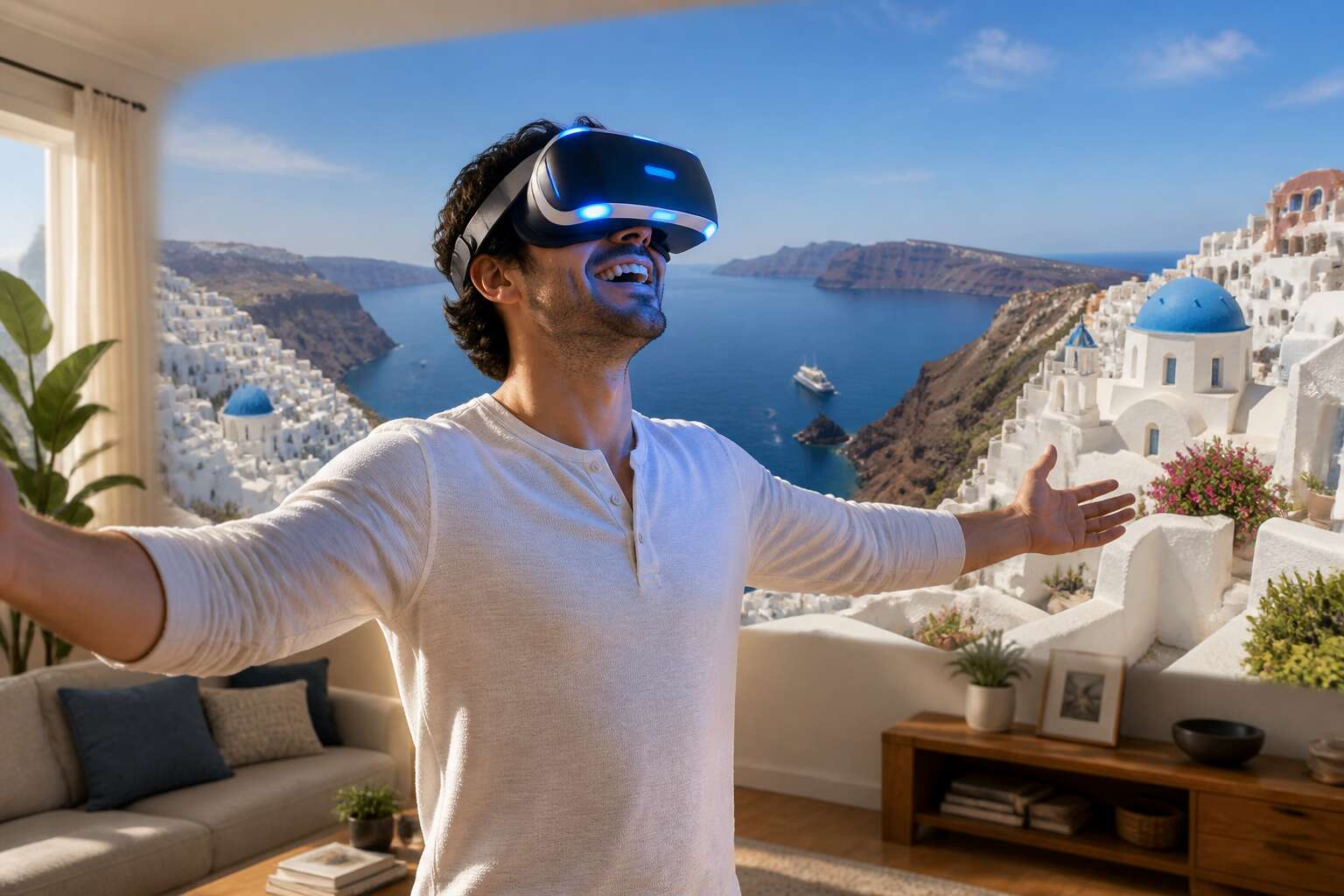
Now, this trajectory culminates in virtual reality travel, which bypasses the proxy of a screen altogether. It engages the vestibular system and the primal instincts of sight and sound to construct a convincing sense of place. The psychological impact is profound; our brains are not merely processing a visual, we are negotiating our place within it. It is a dialogue between the self and the simulated world, a profound shift from the silent films where we could only wonder what it felt like to stand on that faraway shore.
How Mainstream Headsets Transformed the Niche
When the first consumer headsets arrived in the mid-2010s, they offered a proposition more than a finished product. Early adopters wore bulky devices tethered to powerful gaming PCs, trading comfort for a glimpse of what was possible. The hardware was demanding and the content limited, yet the potential was unmistakable.
That potential has since matured. Standalone headsets removed the cables and the price barrier, making virtual reality travel accessible to a wider audience. A user in Johannesburg can walk through a Kyoto temple or dive a Mozambican reef from their lounge. The experience is no longer reserved for early adopters.
Three shifts defined this evolution:
- Standalone hardware removed the need for expensive gaming computers.
- Streaming platforms delivered high quality content to portable devices.
- Tourism boards invested in accurate recreations of popular destinations.
The result is a richer ecosystem where virtual reality travel serves as both a preview and a practical alternative for travellers planning their next journey.
Accessibility: Why Disabled Travelers are Leading the Charge
According to the World Health Organisation, over one billion people live with a disability that complicates conventional travel. This community is not waiting for better ramps. They are redefining what exploration means through virtual reality travel.
From a rented cottage in the Drakensberg, a person with chronic pain can traverse the Great Wall of China without a single step. The headset converts physical barriers into invisible boundaries, and disabled travelers are the first to demand that this world feel authentic. They test the accuracy of audio cues, the faithfulness of textures, and the option to teleport rather than walk.
- Sensory substitution for missing visual or auditory input.
- Customizable movement controls that respect individual mobility.
- Social spaces where representation extends beyond the avatar.
Their insistence on detail elevates virtual reality travel for everyone, turning a convenience into an essential service.
The Psycological Science of Immersive Escapism
Neuroscientists call it presence. It activates the brain’s spatial processing centres. When your virtual reality travel drops you onto Sani Pass, the hippocampus fires as if you are actually there. This neural fidelity explains why armchair exploration has evolved from printed maps to rendered worlds. The psychological science of immersive escapism rests on the brain’s inability to distinguish simulation from lived experience. Memory encodes both the same way. Escapism becomes sensory rehearsal.
Consider what drives a South African to explore from home:
- The need for novelty without physical risk.
- The desire to revisit a childhood landscape exactly as it felt.
- The chance to confront a fear in a controlled space.
Virtual reality travel satisfies these urges by convincing the brain you are elsewhere. The Karoo, the coast, the bushveld become reachable from a living room in Johannesburg!
Building Your Ultimate Immersive Travel Kit
Flagship Headsets: Pushing the Boundaries of Pixation
In the Cape Town sun, a screen’s glare means nothing when you are navigating the fjords of Norway. The essential element of any serious virtual reality travel kit is the flagship headset. These devices push the boundaries of pixation, offering a resolution so crisp you forget the real world.
A flagship headset must handle latency, contrast, and field of view without compromise. I recommend prioritizing headsets that offer substantial pixel-per-degree counts. Here are the specs that matter most:
- High resolution per eye, ideally 4K
- A wide field of view exceeding 100 degrees
- Low persistence blur to reduce motion sickness
These specifications transform a simple video into a visceral experience for your next virtual reality travel excursion. Remember to pack a powerful laptop or dedicated GPU. Without this hardware, your virtual reality travel will stall immediately. This is non-negotiable! The actual quality comes from the seamless interplay between peripheral vision and the lenses.
Audio Imersion: The Undervalued Key to Presence
Audio is the undervalued key to presence in any virtual reality travel experience. The eyes track the fjord’s edge, but the ears confirm it exists. A wave breaks somewhere to the left. A seagull cries from a rooftop outside the frame. These cues build a three dimensional architecture of sound that the visual feed alone cannot sustain.
The realism of a scene dies without acoustic depth. Sharp pixels mean nothing if footsteps land on carpet where stone should echo. The mind catches that inconsistency faster than it registers motion blur.
I have found that a quality pair of headphones outweighs an expensive controller. Spatial audio transforms a passive tour into something closer to memory. The silence between sounds carries equal weight. A distant city humming, wind moving through a gorge, these convince you that virtual reality travel has taken you somewhere real.
Haptic Gloves and Suits: Fealing the Sand of the Sahara
Seventy percent of the brain’s sensory processing is devoted to touch. That statistic explains why haptic gloves and suits matter for virtual reality travel. They translate digital surfaces into physical textures. Your hand brushes a virtual dune, and the glove’s actuators press against your palm. You feel the grit, the weight, the give of the sand.
A full suit adds temperature and wind simulation. The Sahara becomes more than a visual scene. It becomes a climate your body understands.
Essential haptic components for a travel kit:
- Gloves with individual finger tracking
- A vest with localized pressure zones
- Thermal pads for heat and cold
- A cooling fan module
Each element builds feedback that anchors you in the moment. Without them, virtual reality travel remains a passive viewing experience. With them, you kneel and let the sand run through your fingers. That tactile memory stays after the headset comes off.
Motion Sickness Mitigation: Tips for Smooth Sailing
Assembling a kit for virtual reality travel demands more restraint than spending. A quality headset matters, but so do a firm floor space and a chair you trust. The best kit feels unremarkable until you need it.
In my experience, motion sickness plagues many travellers, and the cause is often impatience. You rush to stand and pivot. Instead, begin seated. Use a fan to create a breeze that matches your virtual scene. Reduce the software’s field of view. These small concessions calm your inner ear.
- Choose routes that move forward steadily
- Set a timer for ten minute intervals
- Keep your gaze on the horizon, not the ground
With these habits, your journey becomes a pleasure rather than a queasy chore.
Intenet Requeirements and Latency: Streamig Everest in 8K
Streaming Everest in 8K is a test of patience and fibre optics. Your virtual reality travel setup demands a connection with low latency and stable throughput. Latency, the enemy of presence, turns a Sherpa’s path into a degraded sequence of images. Aim for a ping under 30 milliseconds.
For a smooth ascent, assess your bandwidth. A 50 Mbps line handles 8K with occasional buffering. A 100 Mbps line offers a seamless experience.
- Check that your router’s 5GHz band is active
- Hardwire your headset if possible
- Close every background downloader
Without these, Everest renders as a pixelated blur. Virtual reality travel should move with you, not against you.
Curated Virtual Intineraries – Top Apps and Platfoms
Google Earth VR vs. Wander vs. NatGeo Experienes
A 2023 industry report claims 78% of virtual reality travel fans prefer a scripted route over free-roaming. That is sad, but it explains why Google Earth VR, Wander, and NatGeo Experiences lead the pack. Google Earth VR zooms from orbit to your cousin’s driveway with reckless abandon. Wander offers gentle, narrated walks that feel almost too pleasant. NatGeo Experiences dresses the same landscapes in dramatic music and stern facts.
I have tried all three, and the choice depends on your mood:
- Choose Google Earth VR for pure spatial liberty!
- Choose Wander for a calm, human touch.
- Choose NatGeo Experiences for a dose of guilt about your own ignorance.
Each platform turns the experience into a distinct genre. You are not visiting a place. You are visiting one company’s interpretation of it. The best itinerary might be all three, but only if you enjoy whiplash.
Guided Tous of Global Museums and Galleries
Curated virtual itineraries carry a peculiar authority. They decide what you see and what you miss. For museums and galleries, a guided tour can feel like inheriting a stranger’s memory of the place. I have followed the Louvre’s curated rooms and the Vatican Museums’ single unbroken path. Each one imposes a sequence, a tempo, a way of looking. You are not wandering; you are being walked.
In virtual reality travel, the guide becomes a ghost. Their voice moves ahead of you, naming painters and epochs, while you drift through marble halls at a pace you did not choose. The Rijksmuseum pairs each artwork with two minutes of commentary. The Tate offers thematic routes that ignore chronology entirely.
- Louvre’s online collections present fifty curated rooms.
- Vatican Museums compel a strict, linear procession.
- Google Arts & Culture assembles exhibitions from dozens of institutions.
The effect is intimate and tyrannical. You gain access, but you surrender the freedom to linger. That trade defines virtual reality travel. Some platforms let you break away from the script; most do not. You learn the collection, but you never learn your own impulse within it.
Adrenaline Rushes: VR Safaris and Deep-Sea Dives
Virtual reality travel once meant passive viewing, a screen propped on a desk. The Wild and Ocean Rift changed that. They push curated itineraries into raw terrain. A Kruger safari becomes a guided chase across the savannah, a ranger’s voice tracking lion movements in real time. Deep-sea dives drop you into the Mariana Trench, bioluminescent jellyfish drifting past your visor.
These platforms excel at pacing. They build tension through scheduled encounters, not open exploration:
- The Wild VR delivers timed wildlife corridors, complete with elephant crossings.
- Ocean Rift maps wreck sites and coral reefs with scientific accuracy.
- AltspaceVR hosts live guided expeditions from marine biologists.
You surrender control in exchange for visceral payoff. The sweat on your palms feels real, even when the terrain is not. That is the state of virtual reality travel today.
Fom Pixels to Passpots – Affecting Ral-World Choices
Hotel Preiews: Sleeping in the Suite Befoe You Book
I once walked into a virtual suite and immediately canceled my reservation. That moment revealed how virtual reality travel can shift real choices. Hotel previews now offer more than a photo gallery.
You can open the curtains, check the plumbing, and measure the bed against your own height. These details matter. A room that looks elegant in marketing often fails in VR. For instance:
- Watch the shadow patterns at dusk
- Listen for traffic through the window
- Count the steps to the bathroom
Such sensory checks changed my next booking. The difference startled me! A virtual stroll through the suite reveals what photos hide.
Cruise Ship Cabin Tous: Avoiding the Claustophobic Cabins
Cruise ship cabins demand careful scrutiny. The brochure says “cozy.” The virtual reality travel tour reveals you cannot open the wardrobe without shuffling sideways. I once nearly booked an interior cabin that looked acceptable in photos. The VR walkthrough showed a different story: the bed touched three walls, and the bathroom door swung into the toilet.
During a VR session, check specific things:
- Measure the turning radius at the foot of the bed
- Test closet depth by opening the sliding door
- Confirm the shower elbow room
You can stretch your arms and compare the space against your own bedroom. For claustrophobia sufferers, this is a relief. For everyone else, it is a warning about how cruise lines define “spacious.” The difference between a standard balcony room and a premium suite becomes obvious in seconds.
Cultral Sensitivity Training: Etiquete Befoe Landing
Virtual reality travel can teach you the difference between a thumbs up and an insult before you embarrass yourself in a foreign boardroom. I tested a Japan etiquette module last week. The simulation corrected my bow angle, my shoe placement, and my tendency to hand over cash without a tray. These choices sound small until you make them wrong in public.
A proper cultural sensitivity session should rehearse:
- Greeting rituals for business and social settings
- Dining etiquette, including chopstick placement and seating order
- Tipping norms and how to decline a tip gracefully
- Religious dress codes and temple protocol
- Personal space and acceptable speaking volume
I landed in Tokyo knowing exactly how to enter a meeting room. Virtual reality travel does not replace a local guide. It prevents you from becoming the tourist everyone remembers for the wrong reason.
Family Planning: Kid-Friendly VR Travel to Gauge Intrest
Virtual reality travel lets parents see a destination through a child’s eyes before committing a holiday budget. My nephew refused to remove the headset during a virtual tour of Table Mountain. That reaction told me more than any brochure ever could. A child’s boredom with a simulated museum visit often predicts their real-world patience, so the immersive experience filters out far-off places that look dazzling in photos but fail to spark actual curiosity.
Some signals emerge fast during these sessions:
- Excitement during a virtual beach walk
- Repeated requests to restart a city tour
- Silence during a cultural immersion sequence
These moments give families evidence to plan around, and they convert tiny pixel shifts into concrete travel choices. A VR preview also surfaces hidden anxiety. A child who flinches at virtual crowds will struggle in a busy market. Understanding that before you book a flight saves time, money, and stress. The passport stamp starts in your living room, and every headset session sharpens the family itinerary.
The ‘Try Befoe You Buy’ Economy in Moden Tourism
Virtual reality travel is the séance of the tourism industry. You summon a place before committing your body to it. This is the try before you buy economy, and it operates on evidence, not hope. A traveller in Johannesburg can wander a foreign port before surrendering a single rand to an airline. The headset reveals the crowds, the noise, the light. You learn if the destination rejects you before you ever board a flight.
- Disappointment happens at home, cheaply.
- The itinerary is built on what you actually witnessed.
- The choice is yours, not the brochure’s.
Virtual reality travel converts the unknown into a pre-visited memory. The real journey begins as an echo. You walk streets you have already walked, smell markets you have already smelled, and strangeness arrives pre-digested. This familiarity is not a flaw. It is a filter. When the aircraft descends, the place either confirms the vision or exceeds it. Both outcomes carry a strange certainty.
The Nex Fronier – Synthetic Travel and AI Integation
Ingeating Tactile and Smell Intefaces
The next frontier in virtual reality travel is synthetic. AI now generates entirely original destinations, from floating markets above Neptune to Karoo landscapes that never existed on any map. These worlds feel authentic because the system builds them around your responses. When you look at a virtual baobab tree, the AI adjusts light, wind, and shadow in real time.
Smell interfaces are the breakthrough. Scent cartridges release microdoses of rooibos tea, ocean salt, or rain-soaked earth, synchronised with the scene. Olfactory cues strengthen memory far more effectively than visuals alone. Tactile feedback, layered on top, completes the illusion. Three channels work together:
– A warm breeze from directional fans
– Texture pads that mimic bark or sand
– Temperature shifts across your skin
AI learns which combinations pause and move each traveller. The result is personal synthetic travel, shaped by your curiosity. Nothing was filmed, yet it feels immediate. That is the next shift in virtual reality travel!
Ethical Dilemmas: Digital Pesevation of Endangeed Sites
More than 30,000 heritage sites face existential threats from climate and conflict. Virtual reality travel can immortalise them as digital twins, but the ethics are messy. AI assembles photogrammetry, LiDAR, and archival fragments into faithful reconstructions of faded rock art and eroded architecture. Yet I wonder: who grants permission to digitise a sacred cave? Does a flawless simulation overshadow the original’s meaning? These questions demand answers.
- Consent from local custodians
- Ownership of 3D scans
- Limits on commercial reuse
For South Africa, the dilemma is personal. Virtual reality travel must not bypass the guardians of uKhahlamba Drakensberg rock paintings. Their authority should be the starting point for any digital preservation effort.

0 Comments